US PERM Suspension: 8 Tech Giants Face a Major Green Card Shake-Up for Indian Workers
15 hours ago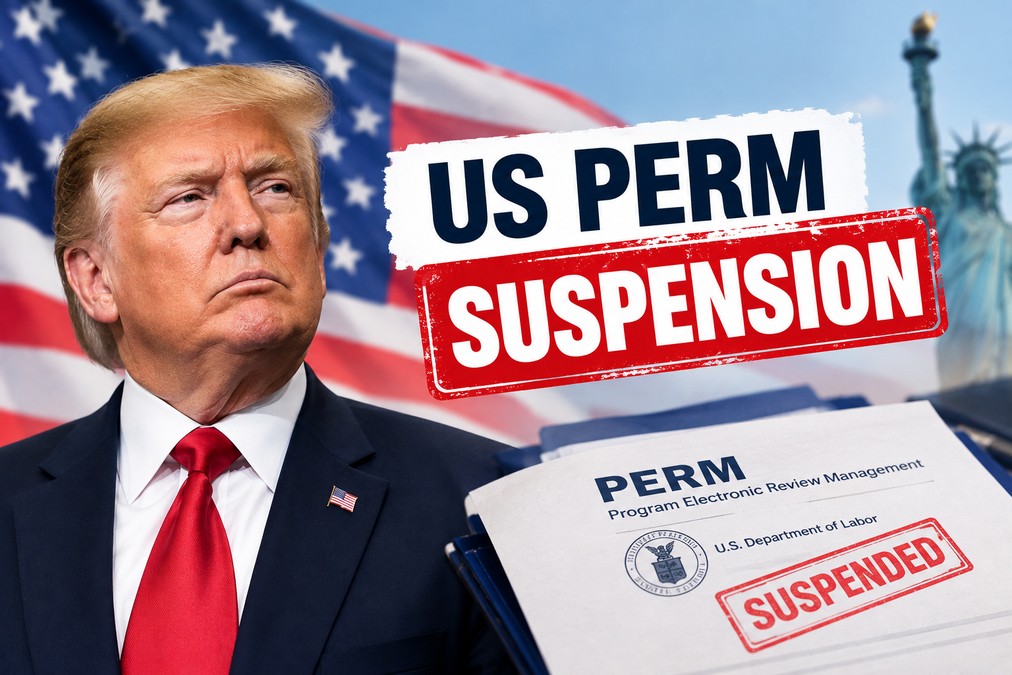
The US PERM Suspension has put thousands of foreign technology professionals in a state of uncertainty, after the Trump administration halted new and pending labour certification applications from eight major technology companies, including TCS, Infosys, Wipro and HCLTech. The move is part of a broader crackdown on employment-based immigration, with officials alleging misuse of visa programmes and prioritising American workers.
For thousands of Indian professionals working in the United States, a stable job has often represented more than a monthly salary. It has also been a potential pathway towards permanent residency, long-term security and a future for their families in America.
That pathway has now become more uncertain.
On October 8, 2026, the US administration announced that it would stop accepting new applications and processing pending applications under the Permanent Labor Certification Programme, commonly known as PERM, involving eight major technology companies. The announcement was made by US Labor Secretary Keith Sonderling alongside Vice President JD Vance, as the administration intensified its scrutiny of foreign-worker programmes.
The companies named were Microsoft, Adobe, Cognizant, Infosys, Tata Consultancy Services (TCS), Wipro, HCLTech and Capgemini. The action has drawn particular attention in India because several of the affected businesses are major employers of Indian technology professionals.
However, the development requires an important distinction: this is a suspension affecting a route towards employment-based permanent residency, not an announcement cancelling every affected employee's existing H-1B visa.
So, what exactly has changed, why is Washington taking this step, and what could it mean for Indian workers and the IT industry?
The US PERM Suspension concerns a process that plays a crucial role in many employer-sponsored Green Card applications.
PERM stands for Program Electronic Review Management. It is administered by the US Department of Labor and is generally the first major stage in the employment-based Green Card process for workers applying through categories such as EB-2 and EB-3.
Before sponsoring an eligible foreign professional through this route, an employer generally needs to demonstrate that it has completed the required recruitment process and that hiring the foreign worker will meet applicable labour-market requirements. This is intended to protect employment opportunities and wages for qualified American workers.
Once the labour certification is approved, the employer can generally proceed with the relevant immigrant petition, followed by the remaining immigration steps, subject to the worker's eligibility and visa availability.
Under the newly announced suspension, the Department of Labor said it would neither accept new PERM applications nor process pending applications involving the eight named companies.
This matters because a delay at the labour certification stage can affect the entire Green Card timeline. Employees who were expecting their employers to begin or continue sponsorship may now have to reconsider their plans.
The precise duration of the suspension and the eventual outcome of individual cases remain important uncertainties.
The announcement covers some of the biggest names in the global technology and IT services industries.
The eight companies named by the US administration are:
The list includes American technology companies as well as multinational IT services firms with substantial operations in India.
For Indian IT companies, the United States is an important market for consulting, software development, digital transformation, cloud services and enterprise technology projects. Their workforce strategies can involve a combination of locally recruited American professionals, employees already based in the US and workers transferred or recruited from other countries.
The suspension could complicate one aspect of this workforce model: the ability to sponsor eligible foreign employees for permanent residency through the affected companies.
However, the announcement does not establish that every employee at these companies is affected in the same way. The consequences will depend on each worker's immigration status, the stage of their application and the employer's future options.
The US administration has justified the action by alleging that certain employers have misused employment-based immigration programmes and relied excessively on foreign workers at the expense of American employees.
Labor Secretary Keith Sonderling argued that the affected firms had sought large numbers of foreign workers over the years. The administration cited historical visa and labour-certification figures to support its position that these programmes require closer scrutiny.
Vice President JD Vance also criticised Microsoft, linking its use of H-1B workers with workforce reductions and arguing that American workers should receive priority for available jobs.
These are the administration's allegations and policy arguments. They should not automatically be treated as proof that every named company committed fraud or unlawfully replaced American employees. Establishing wrongdoing requires evidence and the relevant investigative or legal process.
The broader political objective, however, is clear: the Trump administration wants to increase scrutiny of employment-based immigration and encourage companies to hire more workers from within the United States.
This approach could influence how technology companies recruit, allocate projects and plan their workforces over the coming years.
The most immediate concern surrounding the US PERM Suspension is the uncertainty it creates for Indian professionals who were relying on employer sponsorship to obtain permanent residency.
Employees whose employers have already initiated PERM applications may face a pause in processing. Those who were preparing to start the process may also have to wait.
For professionals who have spent years building their careers in the US, another delay could affect decisions involving home purchases, family relocation, children's education and long-term financial planning.
The impact will not be identical for every worker. Employees at different stages of the Green Card process may face different consequences.
An H-1B visa generally allows eligible foreign professionals to work in the US temporarily for a sponsoring employer, subject to the applicable immigration rules.
It is separate from a Green Card, which provides permanent resident status.
This distinction is particularly important for workers approaching the usual six-year H-1B limit. Certain eligible workers can qualify for extensions beyond that period when specific Green Card-related conditions are met.
For example, some extensions depend on a labour certification or immigrant petition having been filed sufficiently early. If an employee cannot begin the required process because of the suspension, the employee may have fewer options available under those provisions.
That does not mean every H-1B holder will automatically lose work authorisation. Individual circumstances, existing filings, eligibility rules and other available immigration options matter.
For many Indian professionals, working in the US is part of a long-term career and family plan. Permanent residency can offer greater stability than relying on temporary employment-based immigration status.
When employer sponsorship becomes uncertain, workers may reconsider whether to remain in the country, move to another employer or explore opportunities elsewhere.
The situation could be particularly difficult for employees who have already spent several years waiting for permanent residency and cannot easily restart the process with another employer.
The US PERM Suspension could influence Indian IT companies in several ways, although the scale of the impact will depend on how long the restrictions remain in place and how the affected firms respond.
Companies may increasingly prioritise recruiting professionals already authorised to work in the US, including American graduates and experienced local workers.
That could create opportunities for US-based candidates while requiring Indian IT firms to adjust recruitment budgets, project staffing and workforce planning.
Technology companies frequently balance employee availability, skill requirements, client locations and project costs. If staffing becomes less flexible, some firms may need to spend more on recruitment or restructure how they deliver services.
However, the effect should not be assumed to be uniform across the industry. Firms with established US-based workforces may be better positioned than those that rely more heavily on international mobility.
The suspension may make some professionals more cautious about accepting US-based positions if permanent residency sponsorship is an important part of their decision.
Recruiters may also need to communicate more carefully about immigration support, timelines and the limitations of employer-sponsored Green Card pathways.
For Indian professionals considering overseas opportunities, it may become increasingly important to evaluate the full employment package rather than salary alone.
For investors, the development raises questions about labour costs, employee retention, recruitment strategies and the long-term operating models of the affected companies.
However, an immigration-policy announcement does not automatically translate into a major financial setback for every company involved.
Investors would need to assess factors such as the number of employees directly affected, the firms' reliance on PERM sponsorship, the availability of alternative staffing arrangements and any resulting changes in operating costs.
For Indian IT stocks, the broader picture still includes US technology spending, client demand, deal wins, revenue growth, margins, currency movements and quarterly earnings.
The suspension may become a factor in company-specific analysis, but it should not be treated in isolation as a reason to expect every affected stock to fall.
Several questions remain important: how long the suspension will continue, how the authorities will handle individual cases, whether the affected companies will challenge or seek clarification on the action, and whether additional employers could face similar scrutiny.
Workers should distinguish between confirmed changes to their own immigration cases and broader media reports. Anyone whose application may be affected should consult their employer's immigration team or a qualified US immigration attorney before making decisions about employment, travel or visa status.
The suspension is a significant development, but its full consequences will depend on the implementation of the action, subsequent regulatory decisions and the responses of employers and employees.
The US PERM Suspension highlights the growing uncertainty surrounding employment-based immigration in America. For Indian IT professionals, the most immediate concern is the potential delay or interruption of a route towards permanent residency. For employers, the challenge is to balance immigration compliance, local hiring, workforce costs and client commitments.
At the same time, the suspension should not be confused with a blanket cancellation of H-1B visas or an automatic finding of wrongdoing against every company named.
For Indian professionals pursuing the American Dream, the message is to stay informed, understand the stage of their immigration process and seek qualified advice before making major career decisions. For the IT industry, the development reinforces the importance of flexible workforce planning in an increasingly uncertain immigration environment.