JIO Platforms’ Blockbuster Listing: 21.4% Premium Sparks Massive Investor Excitement
14 hours ago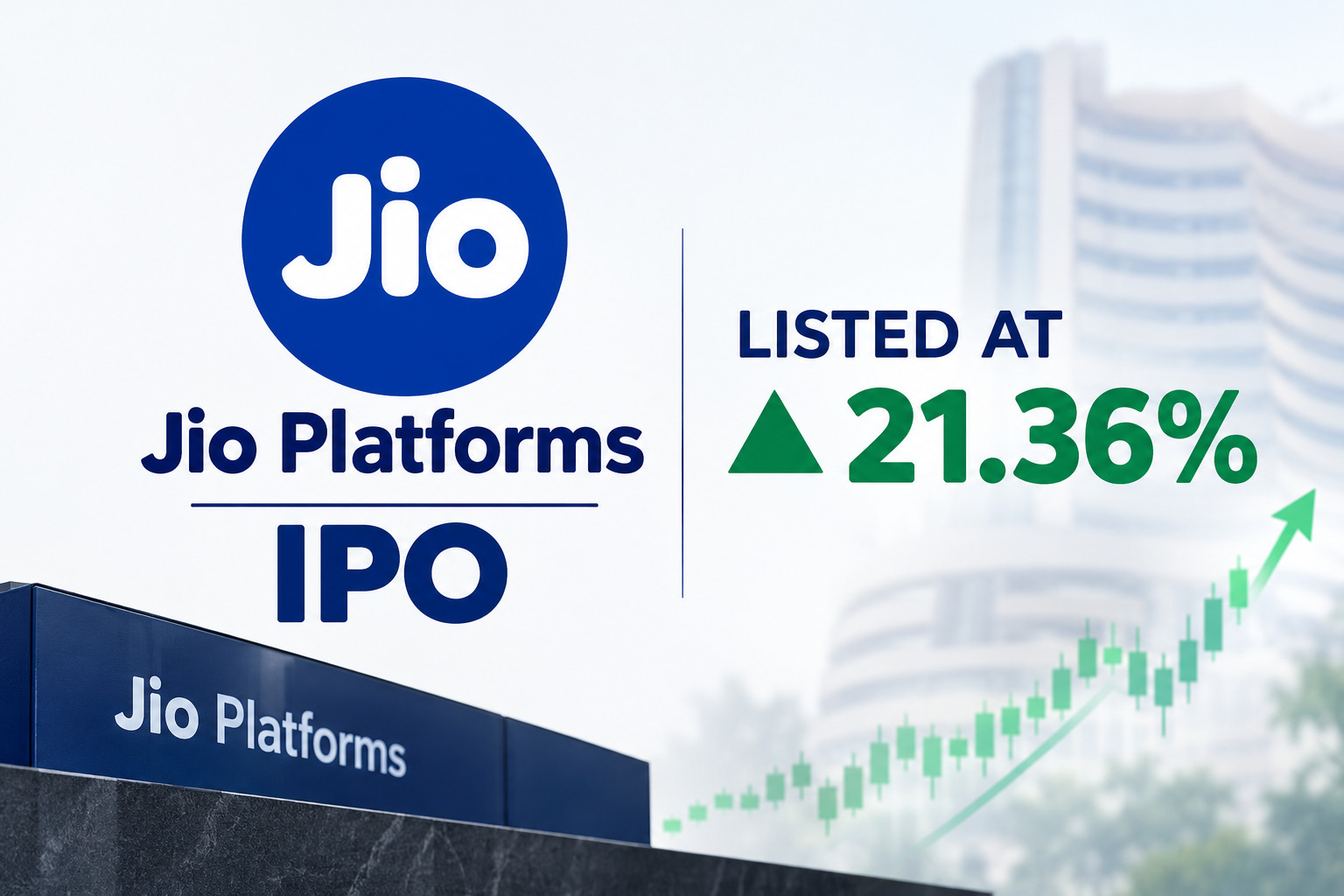
JIO Platforms made a remarkable debut on the Indian stock market on October 28, 2026, listing at ₹1,358 per share against its IPO issue price of ₹1,119. The listing represented a premium of approximately 21.36%, taking the company’s market capitalisation to around ₹12.5–₹12.6 lakh crore. The strong debut placed JIO Platforms among India’s most valuable listed companies, behind its parent, Reliance Industries Limited (RIL).
The listing marks a significant milestone for Reliance Industries’ digital business, which has expanded beyond mobile connectivity into broadband, digital entertainment, cloud computing and enterprise services. It also strengthens JIO Platforms’ position in India’s telecommunications sector, as its market capitalisation moved ahead of Bharti Airtel at the time of listing.
JIO Platforms opened its journey on the National Stock Exchange (NSE) and the Bombay Stock Exchange (BSE) with a strong premium over its IPO price. The shares listed at ₹1,358, compared with the upper end of the issue price band of ₹1,119.
The listing price represented a gain of ₹239 per share for investors who received shares in the IPO. Based on the reported market capitalisation of approximately ₹12.5 lakh crore, JIO Platforms became the second-most valuable listed company in India at the time of its market debut.
Reliance Industries retained its position ahead of JIO Platforms, with a market capitalisation of approximately ₹16.15 lakh crore. Meanwhile, Bharti Airtel, valued at around ₹12.18 lakh crore according to the reported BSE data, ranked behind JIO Platforms.
The listing also made Reliance Industries the country’s most valuable conglomerate, reflecting the combined significance of its businesses across energy, retail, telecommunications and digital services.
For investors allotted the minimum lot of 23 shares under the shareholder category, the listing price translated into a potential gain of ₹5,497 over the issue price, before applicable charges and taxes.
The strong stock market debut followed an exceptionally strong response to the ₹30,213 crore initial public offering (IPO).
The issue opened on October 21, 2026, and closed on October 23, 2026. According to the reported subscription figures, the IPO was subscribed 22.19 times overall, reflecting substantial interest across institutional and individual investor categories.
The company reportedly received more than 1.3 crore applications, making the offering one of the most closely watched public issues in India's capital markets.
Addressing the listing ceremony, Akash Ambani, Chairman of Reliance Jio Infocomm, said the response had exceeded the company's expectations, with demand worth more than ₹7.5 lakh crore.
He highlighted the speed of subscription, noting that the IPO was fully subscribed within approximately 95 to 100 minutes of its launch.
The strong response indicated significant investor interest in JIO Platforms' scale, digital infrastructure and long-term business prospects.
Qualified institutional buyers (QIBs) were the biggest contributors to the IPO's subscription demand. Their portion was subscribed 70.55 times, demonstrating strong participation from institutional investors.
The non-institutional investor category was subscribed 14.09 times, while the retail investor portion received bids amounting to 2.72 times the shares reserved for the category.
The employee category was subscribed 2.93 times, and the shareholder category was subscribed 7.60 times.
Ahead of the public issue, JIO Platforms allotted shares worth approximately ₹8,109.85 crore to 212 anchor investors at the upper end of its price band. Institutional demand for the anchor book exceeded ₹2.5 lakh crore, representing more than 30 times the amount available for allocation.
These figures highlighted the scale of demand for the offering even before it opened to the broader investing public.
The IPO was also reported to have crossed one crore applications, setting a significant benchmark for public offerings globally. The high subscription levels and strong listing premium made JIO Platforms a major event in India's primary market.
One of the biggest developments following the listing was JIO Platforms’ rise above Bharti Airtel in terms of market capitalisation.
The two companies are among India's leading telecommunications players, competing across mobile connectivity, broadband and digital services. However, JIO Platforms’ listing valuation placed it ahead of Bharti Airtel in the reported market capitalisation rankings.
JIO Platforms has built a substantial position in India's digital economy since Reliance entered the telecommunications market around a decade ago. Its growth has been supported by a large subscriber base, extensive network infrastructure and the expansion of digital services.
The company reported 533.3 million subscribers as of June 2026 and carried nearly 60% of India's data traffic, according to reported company figures.
This scale gives JIO Platforms a significant position in a market where demand for mobile data, high-speed connectivity and digital services continues to shape competition.
However, market capitalisation rankings can change with share price movements. The comparison with Bharti Airtel reflects the reported valuations at the time of JIO Platforms’ listing rather than a permanent ranking.
JIO Platforms has evolved beyond its original mobile connectivity business into a broader digital services company. Its offerings span broadband, digital entertainment, cloud services and enterprise solutions.
The expansion reflects Reliance Industries' strategy of building an integrated digital ecosystem that connects consumers, businesses and technology infrastructure.
Its large subscriber base provides an established platform for introducing new services, improving customer engagement and expanding digital consumption. At the same time, growing demand for cloud computing and enterprise technology creates opportunities beyond traditional telecommunications.
JIO Platforms’ scale also gives it access to a substantial volume of data traffic, strengthening its position in India's increasingly connected economy.
The company has invested in building digital infrastructure and developing homegrown platforms to support these services. Its next phase of growth will depend on how effectively it converts this reach into sustainable revenue, profitability and long-term shareholder value.
The ₹30,213 crore IPO was structured entirely as a fresh issue of shares. According to the reported offering details, a portion of the proceeds will be used to repay borrowings at Reliance Jio Infocomm, its telecommunications subsidiary. The remaining amount is earmarked for general corporate purposes.
Reducing debt at the subsidiary level could help strengthen its financial position and support future business requirements. General corporate funds can provide flexibility for operational needs, infrastructure development and other business priorities.
For investors, the utilisation of IPO proceeds will be an important factor to monitor alongside revenue growth, profitability, capital expenditure and the company's competitive position.
The listing also introduces a new group of public shareholders to JIO Platforms, increasing the importance of transparent financial reporting and consistent value creation.
At the listing ceremony, Akash Ambani described the stock market debut as the beginning of a new phase rather than the conclusion of the company's journey.
He emphasised JIO Platforms’ responsibility towards its shareholders and its commitment to creating value through customer-focused innovation.
The ceremony was attended by members of the Ambani family, including Akash Ambani and Isha Ambani. The occasion was marked by a ceremonial gong strike at the NSE.
Akash Ambani also highlighted the company's focus on expanding digital access and strengthening its services for customers. His remarks underlined the importance of protecting shareholder wealth while building the business over the long term.
For a company entering the public markets at such a substantial valuation, maintaining investor confidence will depend on delivering consistent business performance rather than relying solely on a strong initial listing.
The blockbuster listing establishes JIO Platforms as one of India's largest listed companies and highlights investor interest in the country's digital economy.
Its market position, subscriber base and expansion into multiple digital services provide important foundations for future growth. However, the listing premium alone does not determine whether the stock will deliver sustainable returns.
Investors will need to evaluate the company's financial performance, debt levels, growth strategy, valuation and ability to generate cash flows over time. Market conditions and competition in the telecommunications industry will also influence its performance.
The listing is a significant milestone for Reliance Industries as it brings one of its key digital businesses into the public markets.
The key question now is whether JIO Platforms can translate its massive subscriber base and strong market debut into sustained earnings growth and long-term shareholder value. Its performance in the coming quarters will be crucial in determining whether the excitement surrounding its listing is supported by business fundamentals.
published by Traders Circuit.